The midface is where facial aging starts, and it is almost never where patients think their problem is. Someone comes in about dark circles, or about the lines running from nose to mouth, or about a jawline that has gone soft, and the assessment traces all three back to the same place. Cheek volume supports the lower eyelid above it and holds up the tissue below it. When it deflates, the eye hollows, the fold deepens, and the jowl forms, all from one cause.
Sam Assassa, MD has taught injectable facial technique to physicians and nurses in more than 15 countries across three continents and was among the first physicians on the West Coast to introduce the CosmoFaceLift™. He founded Beverly Hills Aesthetics in 1995, is board certified in Internal Medicine, and is a member of the American Academy of Aesthetic Medicine and an affiliate member of the American Academy of Cosmetic Surgery.
“The compliment my patients hear most is that they look rested. Almost nobody guesses it came from the cheeks.” — Sam Assassa, MD
How Cheek Fillers Lift the Midface
Cheek filler restores volume to the upper and mid cheek, and the lift it produces is structural rather than cosmetic. Adding support at the cheekbone raises the tissue resting on it, which softens the fold from nose to mouth, reduces the abrupt step between the lower eyelid and the cheek that reads as a dark circle, and improves definition along the jaw.
That single point explains why the cheek is treated when a patient’s complaint was somewhere else entirely. Filling a nasolabial fold directly, without addressing the deflated cheek that created it, treats a symptom and usually looks it.
The Ogee Curve and Ideal Cheek Proportion
The Ogee curve is the standard used to assess cheek shape, and it is worth understanding because it explains what the treatment is actually aiming at. It describes a gentle S running from the tail of the brow, out across the fullness of the cheek, then tapering in toward the mouth. A youthful face has it. An aging face flattens it.
Restoring that curve is different from adding volume. Volume placed without regard to where the curve should sit produces fullness in the wrong plane, which is the mechanism behind faces that look inflated rather than lifted. Younger patients often want the opposite emphasis, seeking definition at the cheekbone rather than fullness beneath it, and the placement differs accordingly.
Cheek Filler for Stronger Cheekbones in Men
Male aesthetic treatment is a substantial part of this practice, and the technique is genuinely different rather than the same treatment scaled down. Ideal male facial proportion calls for definition and projection at the cheekbone itself, since a strong zygomatic ridge reads as masculine. Fullness in the apple of the cheek, which is often the goal in female patients, reads as feminizing in men.
“Men ask me for cheekbones, not for fuller cheeks. Those are two different injections, and confusing them is exactly how a man ends up looking softer rather than stronger.” — Sam Assassa, MD
Cheek Fillers for Laugh Lines and Nasolabial Folds
Nasolabial folds run from the corner of the nose to the corner of the mouth. They are normal anatomy present in everyone, including children, and the goal is never to erase them. What changes with age is depth, as cheek fat is lost, the cheek descends, and the fold deepens into a crease that can make a resting face read as tired or unhappy.
Because the cause sits above the fold, the correction usually does too. Restoring cheek volume lifts the tissue and softens the fold from its origin. Direct filling of a deep fold has a role in some patients, generally as a secondary refinement rather than as the primary treatment.
Cheek Filler Options and What Each One Does
- Hyaluronic Acid Fillers: Restylane®, Restylane® Lyft, Juvéderm®, and Juvéderm Voluma® for structural midface support, reversible if the result is not what you wanted.
- Calcium Hydroxylapatite: Radiesse® for patients wanting firmer projection and a longer interval between treatments.
- Fat Transfer: Your own processed fat, with a portion establishing a permanent blood supply, appropriate for patients wanting durable correction and willing to accept a more involved procedure.
- Combination With Facial Slimming: For bottom heavy cheeks caused by enlarged masseter or parotid anatomy, cheekbone filler is combined with jaw slimming to reshape the proportion rather than only add to it.
The amount required varies substantially between patients, depending on how much volume has been lost and how much change is wanted. That number is given to you at consultation rather than estimated in advance.
What to Expect From Cheek Filler Treatment in Beverly Hills
Treatment takes roughly forty-five minutes. Results are visible immediately, with swelling and occasional bruising over one to two days, and the final contour settles at about two weeks as the product integrates. Filler in the midface lasts longer than in mobile areas, generally one to two years, because the region moves comparatively little.
Tear troughs are frequently treated in the same session. The transition from lower eyelid to cheek needs to be continuous, and correcting one without the other tends to move the visible problem rather than resolve it.
Cheek Filler Risks and Safety
Cheek filler commonly produces swelling, bruising, tenderness, and temporary firmness while the product settles. Asymmetry can occur and is usually correctable at a follow up visit. Overcorrection is the more common aesthetic complication and is the reason for staged treatment rather than maximal placement in one sitting.
Rarely, filler injected into or compressing a blood vessel can restrict blood flow, causing tissue damage, and in very rare cases has been associated with vision loss. Fat transfer carries its own considerations, including variable graft survival and the small additional risk associated with harvesting.
Individual results vary and no outcome can be guaranteed.
Frequently Asked Questions About Cheek Fillers
How long does cheek filler last?
Cheek filler generally lasts one to two years, which is among the longest durations of any facial filler placement. The midface moves comparatively little, and dense structural fillers formulated for deep placement break down slowly there. Patients often find they need only a partial top up rather than a full retreatment at the two year mark, since some of the original placement is still doing work.
Will cheek filler fix my dark circles?
Frequently yes, though not by treating the circle itself. Much of what patients call a dark circle is a shadow cast by the abrupt step between a deflated cheek and the lower eyelid above it. Restoring cheek volume smooths that transition and the shadow softens. True pigmentation under the eye, as opposed to shadowing, does not respond to filler and needs a different approach, and the two are distinguished at consultation.
How much cheek filler will I need?
It depends on how much volume has been lost and how much change you want, and honest answers range from one syringe for subtle definition to several for significant midface restoration. Patients whose cheeks have deflated substantially over years often need more than they anticipated, because the goal is replacing lost structure rather than adding decoration. Dr. Assassa builds across visits rather than placing everything at once, so the first appointment is frequently not the last.
Do cheek fillers make your face look puffy?
They do when volume is placed without regard to where the Ogee curve should sit, which is the mechanism behind faces that read as inflated. Correct placement rebuilds projection at the cheekbone and lets the tissue below follow, producing lift rather than fullness. Overfilling is the other cause, and it is why treatment here is staged deliberately, with the patient returning to add rather than leaving with the maximum.
Is cheek filler different for men and women?
Substantially, and it is one of the more common places technique goes wrong. Male aesthetic proportion calls for definition and projection along the cheekbone ridge, since that reads as masculine. Female proportion more often calls for fullness across the apple of the cheek. Applying the female approach to a male patient softens the face in exactly the way that patient came in hoping to avoid.
How much does a non-surgical cheek lift cost in Beverly Hills?
Treatment currently ranges from $1,200 to $2,400 depending on the product used and how much a particular face requires. Fat transfer costs more initially and lasts considerably longer, which changes the arithmetic for patients planning long term. Pricing is confirmed at your consultation, current figures are published on the fees page, and several payment options are available.
The Process Non-Surgical Cheeks Lift & Contouring
Consult
30 minutes
Price
$1200 - 2400
Treatment
45 minutes
Downtime
Varies: 1 - 2 days swelling or bruising
Results
Immediate
Duration
1 - 2 Years
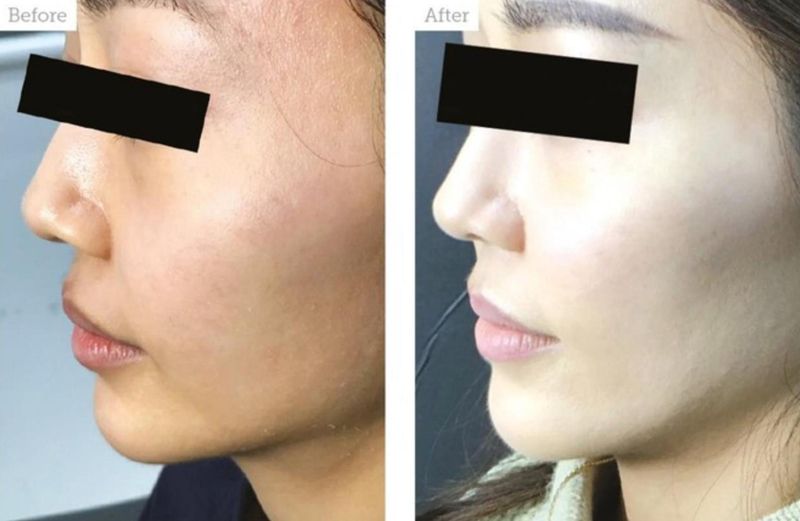
BEFORE & AFTER
Why Patients Choose Beverly Hills Aesthetics for Cheek Contouring
- Whole Face Assessment: Midface volume evaluated as the cause of eyelid, fold, and jawline concerns rather than in isolation.
- Physician Performed: Dr. Assassa places every cheek treatment himself.
- Technique By Gender: Male cheekbone definition and female midface restoration approached as different procedures.
- Staged By Design: Volume built across visits rather than placed at maximum in one sitting.
- Filler And Fat Available: Reversible hyaluronic acid and durable fat transfer both offered, chosen to fit the patient.
Schedule a Cheek Filler Consultation in Beverly Hills
If your face has flattened through the midface, if your laugh lines have deepened, or if the shadows under your eyes have stopped responding to sleep, the cheek is where that assessment starts. Dr. Assassa will evaluate your midface volume and proportion and tell you what restoring it would actually change. Beverly Hills Aesthetics serves patients from Beverly Hills, Los Angeles, West Hollywood, and Century City. Request a consultation or schedule your appointment online.